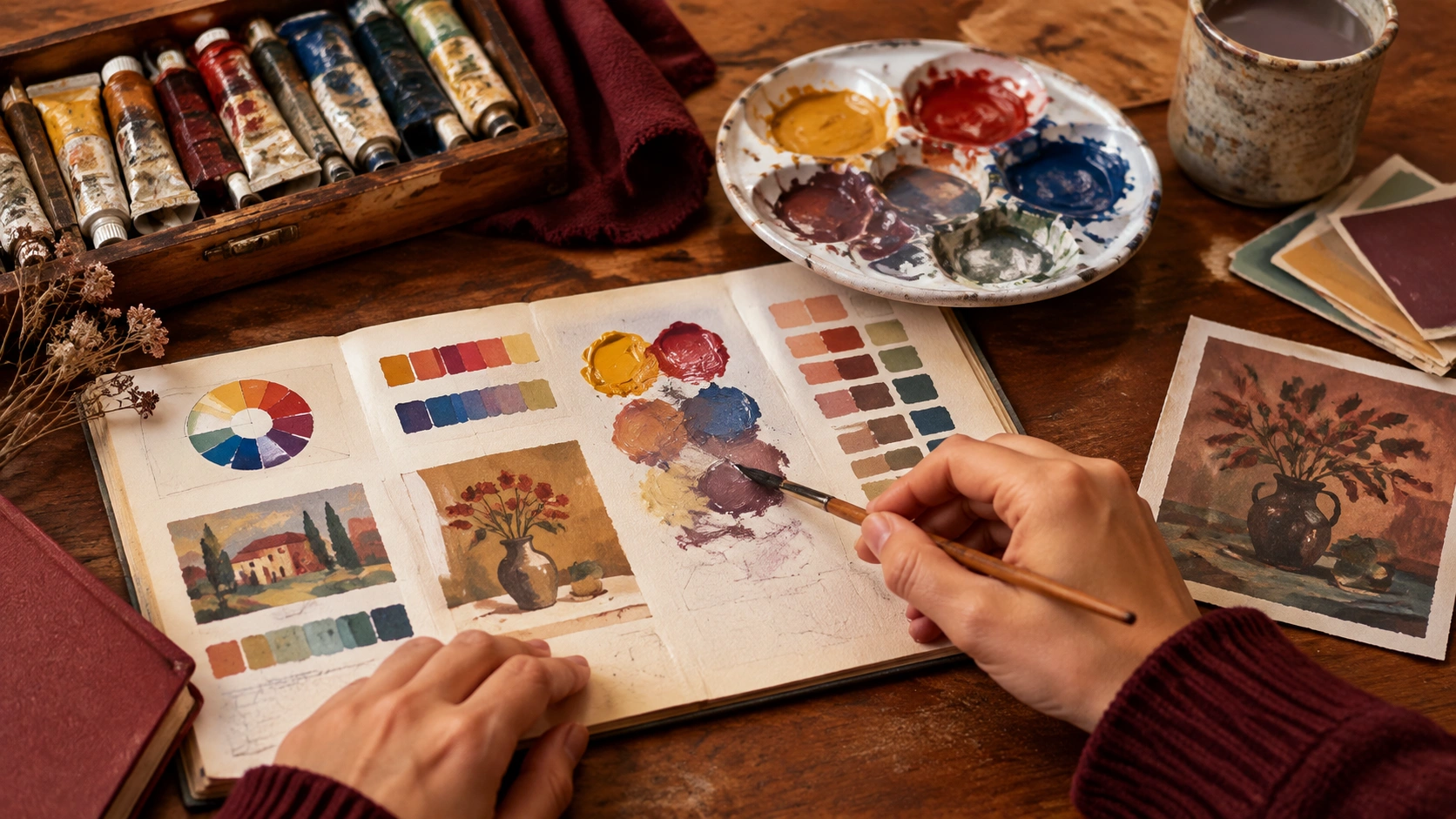
Hands-On Gouache Exercises to Understand Color Mixing, Temperature, and Harmony Without Digital Tools
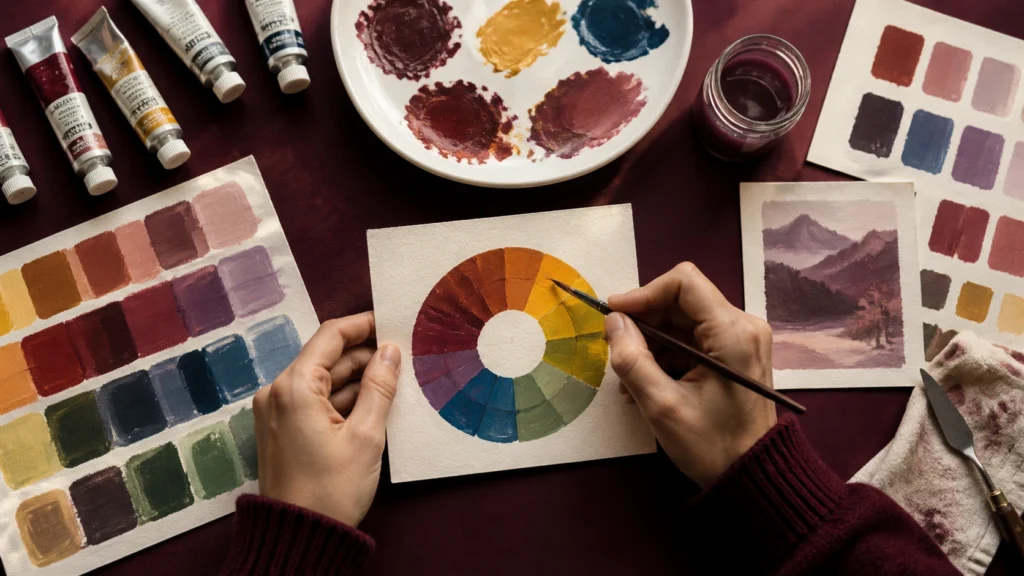
Many artists start color theory on screen, where sliders and undo buttons make every choice feel safe. But physical paint teaches different lessons. Gouache is especially useful because it dries fast, sits flat, and lets you see shifts in hue, value, and saturation in a very direct way. These gouache color mixing exercises for learning color theory help you build real mixing habits you can trust, even when you return to digital work later.
Why gouache is ideal for color study
Gouache is opaque, so you can layer light over dark and compare colors side by side with clean edges. It dries quickly enough to run several studies in one session, but not so fast that you cannot adjust a mix on the palette. Because it is water-based, cleanup is simple, and because it stays matte, you can scan or photograph your studies without glare. All of this makes it a calm, practical tool for studying color temperature, mixing accuracy, and harmony.
What you need
Start with a small, reliable set: titanium white, ivory black, a warm yellow like cadmium yellow deep, a cool yellow like lemon yellow, a warm red like cadmium red, a cool red like quinacridone or alizarin crimson, a warm blue like ultramarine, and a cool blue like phthalo or cerulean. Add a neutral earth like yellow ochre if you have it. Use two or three small brushes, two water containers, a flat palette or ceramic plate, a few sheets of heavy paper or a small gouache pad, and a soft pencil for notes.
Warm-up: neutral grays and color bias
Mix a row of grays by pairing complements: yellow and violet, red and green, blue and orange. Try to land on neutral middle grays without using black. This reveals the hidden bias inside each pigment. If your gray leans warm, your warm color is stronger. If it leans cool, your cool color is dominant. Keep each puddle separate, label them, and paint a small swatch beside your notes. This simple study builds sensitivity to bias, which matters more than memorized rules.
Exercise 1: a limited palette mixing chart
Choose three primaries. Many artists start with a warm and cool version of each primary, but you can also try one yellow, one red, and one blue. Mix each pair at three ratios: mostly the first color, equal parts, and mostly the second. Paint each result as a small square. You will get a basic grid of secondaries and subtle grays. The goal is not to make a perfect chart. The goal is to see how your specific pigments behave, because every tube is different.
What to notice
- Which mixtures feel clean and bright? Those pairs keep strong chroma through the middle of the mix.
- Which mixtures turn muddy quickly? That often means the two pigments have strong complementary content or one pigment is very dominant.
- Where does the hue shift? Some mixtures jump from yellow to olive before reaching green. That jump is useful information.
Exercise 2: temperature scale
Pick one hue, such as green. Mix a warm version and a cool version. Then make a five-step scale from the warmest green to the coolest green. Use small amounts of a complement or a neutral earth to lower chroma in the middle steps. Paint each step as a clean swatch. This builds control over temperature, which is often more important than hue name in a painting.
Why this helps
Temperature controls depth and mood. Warm colors tend to advance, cool colors tend to recede. If you can shift temperature without changing the subject, you can guide the eye without relying on contrast alone.
Exercise 3: value and saturation under control
Mix five steps of a single color from dark to light by adding white gradually. Then, for the middle value, make three versions: pure, slightly desaturated, and strongly desaturated. Paint them side by side. This shows how value and saturation work as separate forces. Many mixing problems happen because we confuse the two.
A small test
Look at your swatches from a distance. The desaturated version may feel more natural in a quiet area, while the purer version may work as a focal accent. Learning this in paint helps you make stronger choices in digital painting too.
Exercise 4: harmony studies from a simple subject
Choose a small subject with only two or three masses, like a cup on a table, a piece of fruit, or a folded cloth. Paint it three times using different harmonies: analogous, complementary, and split complementary. Keep the drawing simple. Focus on how the harmony changes the mood without changing the subject.
Recording choices
Write the exact mixes under each study. Note which colors you used for shadows and which for lights. Over time, this becomes your personal mixing library, more useful than generic charts because it is built from your eyes and your hand.
Exercise 5: gray path mapping
Mix two complements, such as ultramarine and burnt orange, or phthalo green and quinacridone red. Create a long row of steps from one color to the other. Try to make the middle steps feel as neutral as possible. This is a gray path. It teaches you how to move through neutral space without losing control. You can then place a pure accent next to a neutral passage and see how the accent sings.
Working slowly and calmly
Give each exercise ten to twenty minutes. Do not aim for beautiful pictures. Aim for clear information. Let each swatch dry before you judge it, because gouache often shifts lighter as it dries. If a mix looks too strong, try adding a little of its complement instead of white or black. If a mix looks dull, try a different primary with more chroma. Small adjustments build understanding.
How these exercises connect to digital work
When you mix on a palette, you learn how pigments interfere with each other. You see that hue, value, and saturation are not separate sliders but tangled forces. That knowledge makes your digital choices more intentional. You will recognize when a color needs to be cooled, warmed, lightened, or calmed, and you will know what move will likely get you there.
A simple weekly routine
- Day one: Neutral grays from complements.
- Day two: Limited palette chart.
- Day three: Temperature scale in one hue.
- Day four: Value and saturation study.
- Day five: Small harmony study from a simple subject.
After a few weeks, you will see faster, calmer mixing and a stronger sense of color temperature and harmony. These gouache color mixing exercises for learning color theory do not replace observation, but they train your hand and eye to work together. That is the foundation of strong creative skills, whether you paint on paper, canvas, or screen.